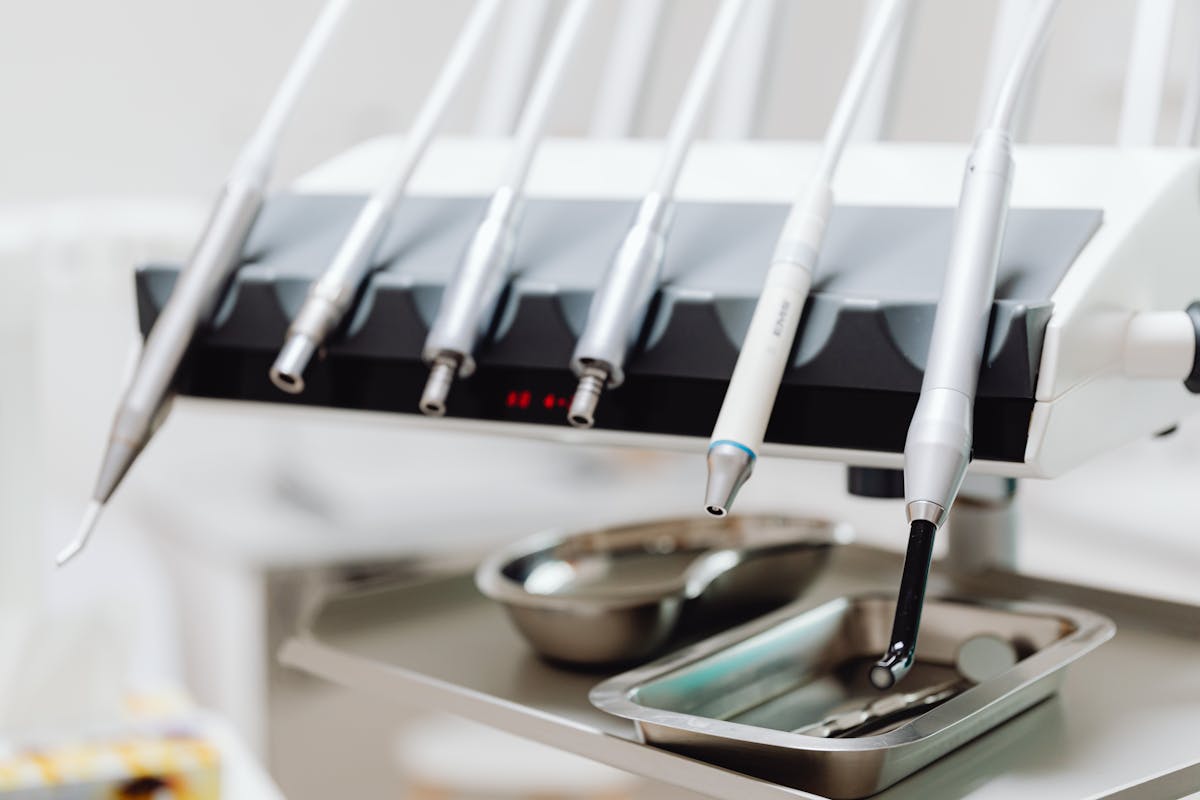
This guide compares the air polishing equipment a European clinic can buy in 2026, in three groups: handpieces that mount on the dental unit's coupling, tabletop units that only air-polish, and combined tabletop systems that add an ultrasonic scaler. Every specification comes from manufacturer documentation or distributor listings, and every price is a public listing checked on 8 October 2026, ex-VAT unless marked otherwise. Preventio Hub has not bench-tested these devices and does not rank them. Brands are listed alphabetically.
What are the three types of air polisher?
| Type | What it does | Air, water and power | Public EU prices we found |
|---|---|---|---|
| Handpiece | Air polishing only | The dental unit's air and water, through the turbine coupling | €328 to about €1,600 ex-VAT |
| Air-only tabletop | Air polishing only, with its own controls | Varies by model; the EMS AIRFLOW One needs mains power (100–240 V) and compressed air at 4.5–7 bar | €8,293 ex-VAT (EMS AIRFLOW One); no public EU price found for the Cavitron Prophy-Jet |
| Combined tabletop | Ultrasonic scaling and air polishing in one unit | Mains power; water and air connections or reservoirs vary by model (EMS AIRFLOW Prophylaxis Master: water 2–5 bar, air 4.5–7 bar; Woodpecker PT-E: 1,400 ml water tank) | €5,657.61 (Cavitron Jet Plus, DMI Ireland, VAT not stated) to €8,143 ex-VAT (same unit, Dentaltix France); none for the EMS units |
For the size of the market and the companies in it, see our 2026 air polishing market overview. For the practical differences between a handpiece and a tabletop unit, see cordless vs tabletop air polishers.
Handpieces that mount on the dental unit
A handpiece air polisher connects to the dental unit's high-speed (turbine) coupling and uses the unit's air and water, so it needs no separate box or power supply. Coupling versions differ by brand, so check that a version exists for your unit before ordering.
Acteon AIR-N-GO easy
Acteon's AIR-N-GO easy attaches to the dental unit's high-speed connection and switches between supragingival and subgingival work by changing the nozzle: a SUPRA nozzle for polishing, and PERIO-family nozzles (sold in Acteon's Perio kit) for non-surgical treatment in pockets of 3–8 mm around teeth and implants. Acteon's brochure lists three powders: CLASSIC (sodium bicarbonate), PEARL (calcium carbonate) and PERIO (glycine). Adaptor versions exist for KaVo, Sirona, W&H, Bien-Air and Midwest couplings. A major EU online distributor listed it at about €1,035 ex-VAT in October 2026 (recommended price about €1,479). Read our AIR-N-GO easy review.
EMS AIRFLOW Handy 3.0, 3.0 PERIO and 3.0 PLUS
EMS sells its coupling-mounted air polisher in three versions. According to EMS product information, the Handy 3.0 is for supragingival work with EMS's CLASSIC, CLASSIC COMFORT and SOFT powders; the Handy 3.0 PERIO, with a PERIOFLOW nozzle, is for pockets deeper than 4 mm; and the Handy 3.0 PLUS runs AIRFLOW PLUS erythritol powder (14 µm, per EMS), which distributor listings describe for visible tooth surfaces and pockets up to 4 mm. Dentaltix France listed the Handy 3.0 PLUS at €1,600.14 and the Handy 3.0 (KaVo MULTIflex or Sirona connection) at €1,369.43 ex-VAT in October 2026.
NSK Prophy-Mate neo
The Prophy-Mate neo has interchangeable 60° and 80° nozzle heads and rotates through 360°. NSK states that it can be washed in a thermodisinfector and autoclaved at up to 135 °C, and lists versions for seven coupling types. NSK's FLASH pearl powder is calcium carbonate (54 µm, per NSK), not sodium bicarbonate; for subgingival work NSK sells a separate handpiece, the Perio-Mate. A major EU online distributor listed the Prophy-Mate neo at about €885–€917 ex-VAT in October 2026 (recommended price about €1,106–€1,146). Read our Prophy-Mate neo review.
W&H Proxeo Aura
The Proxeo Aura has an adjustment ring that changes the working pressure between supragingival and subgingival use. Dentaltix France listed two kits in October 2026: the Prophy kit at €940.49 and the Perio kit at €1,225.50 ex-VAT, with versions for several turbine connections (W&H, KaVo MULTIflex, NSK and Sirona among them).
Woodpecker AP-H
The AP-H comes apart in three sections for cleaning and has a transparent powder chamber and a 360° nose cone. Distributor listings give a weight of 119–125 g, an input air pressure of 3.5–4.5 bar and water at 0.7–2.2 bar, and recommend sodium bicarbonate or glycine powders of 40–65 µm. Dentaltix France listed it at €328 ex-VAT in October 2026; the AP-H Plus, which adds a subgingival nozzle, was €428. Read our AP-H review.
Tabletop units for air polishing only
These units have their own controls and powder chambers but no ultrasonic scaler, so they sit alongside the scaler a surgery already has.
Dentsply Sirona Cavitron Prophy-Jet
Dentsply Sirona sells the Cavitron Prophy-Jet as a standalone tabletop air polisher with Tap-On technology and a wireless foot pedal. Prophy-Jet is also the name of Dentsply Sirona's sodium bicarbonate powder. Dentsply Sirona's US online shop shows the price only to signed-in customers, and we found no public EU or UK price. For Dentsply Sirona's combined unit, see the Cavitron Jet Plus below.
EMS AIRFLOW One
The AIRFLOW One is EMS's air-polishing-only tabletop. EMS's product page lists AIRFLOW MAX and PERIOFLOW MAX handpieces, a touch panel, chambers for CLASSIC (sodium bicarbonate) and PLUS (erythritol) powders, dimensions of 290 × 205 × 245 mm, a weight of 5 kg in operating condition and a compressed-air supply of 4.5–7 bar. UK distributor listings describe it as an option for clinicians who already have a PIEZON scaler module. EMS still shows the AIRFLOW One on its device list; Henry Schein UK and Kent Express listed it as discontinued by the supplier. Dentaltix France and Spain listed it at €8,293.45 ex-VAT, shown as temporarily unavailable, in October 2026.
Combined tabletop systems
A combined tabletop system puts an ultrasonic scaler and an air polisher in one unit with one water supply. Short profiles follow; the combined tabletop comparison sets the published specifications side by side.
Acteon OPUS
Launched at IDS 2025, the OPUS pairs Newtron piezoelectric scaling (compatible with more than 70 Newtron tips) with the Silky Pen air polisher and its four nozzles: Supra, Perio easy, Perio and Perio Maintenance. A UK distributor lists W 250 × H 270 × D 320 mm, 3.7 kg, an 800 ml water tank and Silky Supra and Silky Perio powders in the starter kit, at £6,295 retail. We found no public EU price.
Dentsply Sirona Cavitron Jet Plus
The Jet Plus combines a Cavitron 30K ultrasonic scaler with an air polisher; DMI and DD Group list it with Tap-On technology. An older service manual for the unit gives 30,000 strokes per second and lists PROPHY-JET sodium bicarbonate and JET-Fresh aluminium trihydroxide powders. Listed prices in October 2026: €8,143.34 ex-VAT at Dentaltix France (shown as unavailable), €5,657.61 at DMI Ireland (VAT treatment not stated on the page) and £5,522.82 UK retail at DD Group.
EMS AIRFLOW Prophylaxis Master
The AIRFLOW Prophylaxis Master combines AIRFLOW (supragingival) and PERIOFLOW (subgingival) air polishing with PIEZON scaling (24–32 kHz, up to 8 W, per EMS's instructions for use) and heats the treatment water (unheated or 25, 30, 35 and 40 °C). EMS presents the GBT Machine as its successor. An EMS distributor states that EMS devices are designed and tested for use with EMS powders only. The EU and UK distributors we checked do not list a public price. Read our AIRFLOW Prophylaxis Master review.
EMS GBT Machine
Launched at IDS 2025 as the successor to the AIRFLOW Prophylaxis Master, the GBT Machine adds automatic handpiece recognition, an automated mode for EMS's Guided Biofilm Therapy (GBT) protocol, a PIEZON PS NO PAIN MAX module, a MyEMS connected dashboard and a single water bottle for both handpieces, according to EMS launch material. The distributors we checked do not list a public price. For how GBT compares with other prophylaxis protocols, see our protocol comparison.
Mectron Combi Touch
The Combi Touch combines a piezoelectric scaler (24–36 kHz automatic scan, with endo, perio/scaler, restorative and soft modes) with an air polisher that has Prophy and Perio functions and two removable powder containers, so two powders can be loaded at once. The polishing water is heated, and Mectron's manual gives L 410 × W 260 × H 145 mm and 4.8 kg. Dentaltix France listed it at €6,190 ex-VAT (Perio configuration) or €6,890 with a trolley in October 2026. Read our Combi Touch review.
NSK Varios Combi Pro2
The successor to the Varios Combi Pro pairs a Varios piezoelectric scaler (28–32 kHz, up to 11 W) and titanium scaler handpieces with an air polisher and a wireless foot control. NSK lists the control unit at W 249 × D 290 × H 115 mm and 3.5 kg without the irrigation bottle and powder chamber. Dentaltix listed the basic set at €5,833–€5,899 ex-VAT (France and Spain) in October 2026, and a UK distributor at £7,196.98 retail. Read our Varios Combi Pro2 review.
Woodpecker PT-E
Distributor listings describe a piezoelectric scaler (30 ± 5 kHz, 3–20 W, six modes) with separate supragingival and subgingival air polishing handpieces, an LED air polishing handpiece, four water-heating settings each for scaling and polishing (25–40 °C for polishing), a 1,400 ml water tank, a touch interface in 15 languages and a wireless multifunction pedal. EU distributors listed it at €6,399 (Esadental, Italy) to €6,999 with a trolley (Foquim, Portugal) ex-VAT in October 2026. In the EU, Woodpecker's Super Powder is a glycine formulation.
All fifteen devices at a glance
| Device | Type | Public price | Where listed (checked 8 Oct 2026) |
|---|---|---|---|
| Acteon AIR-N-GO easy | Handpiece | ~€1,035 ex-VAT | Dentaltix FR |
| Acteon OPUS | Combined tabletop | £6,295 (UK retail) | DD Group (UK); no public EU price found |
| Dentsply Sirona Cavitron Jet Plus | Combined tabletop | €8,143 ex-VAT | Dentaltix FR (unavailable); DMI Ireland €5,657.61, VAT not stated |
| Dentsply Sirona Cavitron Prophy-Jet | Air-only tabletop | Not published | No public EU/UK price found |
| EMS AIRFLOW Handy 3.0 | Handpiece | ~€1,369 ex-VAT | Dentaltix FR |
| EMS AIRFLOW Handy 3.0 PLUS | Handpiece | ~€1,600 ex-VAT | Dentaltix FR |
| EMS AIRFLOW One | Air-only tabletop | €8,293 ex-VAT | Dentaltix FR/ES (temporarily unavailable) |
| EMS AIRFLOW Prophylaxis Master | Combined tabletop | Not published | No public EU/UK price found |
| EMS GBT Machine | Combined tabletop | Not published | No public price found |
| Mectron Combi Touch | Combined tabletop | €6,190–€6,890 ex-VAT | Dentaltix FR |
| NSK Prophy-Mate neo | Handpiece | ~€885–€917 ex-VAT | Dentaltix EN/FR |
| NSK Varios Combi Pro2 | Combined tabletop | €5,833–€5,899 ex-VAT | Dentaltix FR/ES |
| W&H Proxeo Aura | Handpiece | ~€940 ex-VAT (Prophy kit) | Dentaltix FR |
| Woodpecker AP-H | Handpiece | ~€328 ex-VAT | Dentaltix FR |
| Woodpecker PT-E | Combined tabletop | €6,399–€6,999 ex-VAT | Esadental IT; Foquim PT (with trolley) |
Powder chemistry and powder prices
Powder chemistry is fixed partly by the device and partly by patents. EMS holds the European patent on erythritol air polishing powder, so on the EU market only EMS devices use erythritol; other brands' devices use powders such as sodium bicarbonate, glycine or calcium carbonate. Check the instructions for use before loading another brand's powder: an EMS distributor, for example, states that EMS devices are designed and tested for EMS powders only. For how the powders differ clinically, see our powder selection guide.
| Powder | Chemistry (as stated by maker or seller) | Pack | Price ex-VAT | Per 100 g | Listed by |
|---|---|---|---|---|---|
| Acteon AIR-N-GO bicarbonate | Sodium bicarbonate | 4 × 250 g | €50.90 | €5.09 | Dentaltix FR (shown unavailable) |
| Dentsply Sirona Cavitron Prophy-Jet, Fresh Mint | Flavoured sodium bicarbonate | 13 oz (≈369 g) | €55.54* | ≈€15.07* | DMI Ireland |
| EMS AIRFLOW PLUS | Erythritol, 14 µm | 400 g | €89.00 | €22.25 | Dentaltix FR |
| Mectron Glycine Powder Sensitive | Glycine | 2 × 160 g | €65.00 | €20.31 | Dentaltix FR |
| NSK FLASH pearl | Calcium carbonate, 54 µm | 4 × 300 g | €83.33 | €6.94 | Dentaltix FR |
| W&H Prophylaxis Powder SOFT | Sodium bicarbonate, 40 µm | 4 × 250 g | €115.26 | €11.53 | Dentaltix FR (shown unavailable) |
| Woodpecker Fast PT-S1 | Sodium bicarbonate | 300 g | €14.95 | €4.98 | Dentaltix FR |
| Woodpecker Gentle PT-S3 | Glycine, 25 µm | 120 g | €14.80 | €12.33 | Dentaltix FR |
Public listings checked on 8 October 2026. "Shown unavailable" means the distributor showed a price but no stock. *DMI does not state next to the price whether VAT is included. The per-100 g figure is the pack price divided by its weight.
What running costs can you work out in advance?
Two running costs can be priced from public sources: the device and the powder. We did not find published service-contract prices or nozzle replacement intervals that would allow a comparison, so ask the distributor for both in writing.
Powder use per treatment is not published by manufacturers either. The only measurement we found is a laboratory study funded by EMS, in which two of the four authors were affiliated with EMS (Donnet et al., Applied Sciences, 2021). It measured mean powder use of 1.0 to 2.9 g per minute for three combined tabletop units in subgingival mode, and assumed a 10-minute full-mouth treatment, which corresponds to roughly 10 to 29 g per treatment. Your own records over a few weeks are a better guide than either figure. Our profitability calculator uses public device and powder prices and lets you set powder use yourself.
How do you choose between the three types?
- Do you already have a scaler you want to keep? A handpiece or an air-only tabletop adds air polishing without replacing it. A combined unit replaces the scaler too.
- What does your dental unit supply? A handpiece depends on the unit's coupling type and air pressure (the Woodpecker AP-H, for example, is listed for 3.5–4.5 bar). Tabletop units state their own water and air requirements; check them against your surgery's supply.
- Which powders do you plan to use? Erythritol is available only on EMS devices in the EU. The Mectron Combi Touch has two removable powder containers, so two powders can be loaded at once.
- Do you want heated water? A handpiece uses the dental unit's water. Several tabletop units heat it themselves, including the AIRFLOW Prophylaxis Master, the Mectron Combi Touch and the Woodpecker PT-E.
- How will you reprocess it? Check autoclave limits and cycle counts in the instructions for use: NSK states 135 °C for the Prophy-Mate neo, and EMS gives 1,000 sterilisation cycles for the AIRFLOW Prophylaxis Master handpieces.
Questions to ask the distributor
- What is the ex-VAT price, and exactly what does it include (trolley, handpieces, nozzles, starter powders)?
- Which powders does the device accept in the EU, and what do they cost per pack?
- What water and air pressures does it need, and does it need mains power?
- What is the written service turnaround, and is a loan unit available during repairs?
- How long is the warranty, and does it depend on annual servicing?
- Is the model current, or has it been succeeded, and for how long will parts be supplied?
- Can you try it in your own surgery before buying?
Frequently asked questions
What is the difference between a handpiece and a tabletop air polisher?
A handpiece mounts on the dental unit's turbine coupling and runs on the unit's air and water. A tabletop unit has its own controls and connects to mains power, water and compressed air. Combined tabletop systems also include an ultrasonic scaler.
How much does an air polisher cost in Europe in 2026?
Public ex-VAT listings checked on 8 October 2026 ranged from €328 (Woodpecker AP-H) to about €1,600 (EMS AIRFLOW Handy 3.0 PLUS) for handpieces, and from €5,833 (NSK Varios Combi Pro2) to €8,143 (Dentsply Sirona Cavitron Jet Plus at Dentaltix France) for combined tabletop systems with a public price; DMI Ireland listed the Cavitron Jet Plus at €5,657.61 without stating VAT treatment. The EMS AIRFLOW One, an air-polishing-only tabletop, was listed at €8,293. We found no public price for the EMS AIRFLOW Prophylaxis Master or GBT Machine.
Which air polishers can use erythritol powder in the EU?
Only EMS devices, such as the AIRFLOW Handy 3.0 PLUS and the AIRFLOW Prophylaxis Master. EMS holds the European patent on erythritol air polishing powder, so other brands' devices sold in the EU use powders such as sodium bicarbonate, glycine or calcium carbonate.
How much powder does one treatment use?
Manufacturers do not publish a per-treatment figure. One laboratory study funded by EMS (Applied Sciences, 2021) measured 1.0 to 2.9 g per minute for three combined tabletop units in subgingival mode; for the 10-minute full-mouth treatment the authors assumed, that is roughly 10 to 29 g.
What should I ask a distributor before buying?
The ex-VAT price and exactly what it includes, which powders the device accepts and what they cost, the air and water pressures it needs, service turnaround and loan units, the length and conditions of the warranty, and whether the model is current or has been succeeded.
Sources
- Acteon AIR-N-GO easy: Dentaltix listing; Optident Perio kit listing; Acteon brochure (PDF).
- Acteon OPUS: DD Group listing; Dental Tribune product page.
- Dentsply Sirona Cavitron Prophy-Jet: Dentsply Sirona product page; Dentsply Sirona US shop.
- Dentsply Sirona Cavitron Jet Plus: DMI Ireland; DD Group; Dentaltix; older service manual (PDF).
- EMS AIRFLOW Handy 3.0 family: EMS product information (ZWP online); Dentaltix, Handy 3.0 PLUS; Dentaltix, Handy 3.0.
- EMS AIRFLOW One: EMS product page; Henry Schein UK; Kent Express; Dentaltix.
- EMS AIRFLOW Prophylaxis Master: EMS instructions for use, technical description; Optident listing.
- EMS GBT Machine: EMS launch announcement as reported by Scottish Dental magazine (March 2025).
- Mectron Combi Touch: Mectron manual, technical data; Dentaltix listing.
- NSK Prophy-Mate neo and FLASH pearl: NSK product page; Dentaltix listing; Dentaltix, FLASH pearl.
- NSK Varios Combi Pro2: NSK product information; Dentaltix listing; DD Group listing.
- W&H Proxeo Aura and powders: Dentaltix, Prophy kit; Dentaltix, Perio kit; W&H prophylaxis powders; Dentaltix, SOFT powder.
- Woodpecker AP-H, PT-E and powders: Dentaltix, AP-H; Dentaltix, AP-H Plus; Net32 listing; Esadental, PT-E; Foquim, PT-E; Dentaltix, Fast PT-S1; Dentaltix, Gentle PT-S3.
- Other powders: Dentaltix, Acteon bicarbonate; DMI, Cavitron Prophy-Jet powder; Dentaltix, EMS AIRFLOW PLUS; Dentaltix, Mectron Glycine Powder Sensitive.
- Powder use: Donnet M, Fournier M, Schmidlin PR, Lussi A. A novel method to measure the powder consumption of dental air-polishing devices. Applied Sciences 2021;11(3):1101. doi:10.3390/app11031101 (funded by EMS).