The dental prophylaxis market is shifting—and if you've been paying attention to recent product launches, you've noticed the trend. Handpiece and portable air polishing systems are gaining traction at a pace that's hard to ignore. They're cheaper than traditional tabletop units, require less chair-side space, and promise simpler clinical workflows. But the question every practice manager and clinician is asking remains unanswered: Can they actually replace full tabletop systems?
The short answer is: it depends. But let's dig deeper.
The Three Categories: Understanding the Landscape
Before we can compare, we need to clarify what we're actually comparing. The air polishing market now breaks into three distinct categories, each with its own clinical profile, cost structure, and use case.
1. Handpiece-Only Systems (Connect to Dental Unit Coupling)
These are the true "cordless" or at least most portable option. They attach to your dental unit's existing air and water supply—you're not actually cutting the cord, but you're eliminating the standalone console.
- Acteon AIR-N-GO: Offers both supragingival and subgingival modes with multiple coupling options. Clean integration if your unit supports the connection.
- NSK Prophy-Mate neo: Compact design with selectable 60° and 80° nozzles for clinical flexibility. Popular in smaller practices.
- W&H Proxeo Aura: Streamlined mode-switching via an adjustment ring. Intuitive for clinicians who frequently change between supra and subgingival work.
- Woodpecker AP-H: The budget option at approximately 125g, fully detachable. Entry-level practices often start here.
2. Compact/Portable Tabletop Systems
These blur the line between handpiece and tabletop. They maintain the footprint advantage of handpieces but offer some of the control and multi-functionality of tabletop units.
- EMS AIRFLOW ONE: Touch-panel control in a compact form factor. Ideal for practices wanting tabletop features without the floor space commitment.
- Woodpecker AP-A/PT-E: Dual-function design with Bluetooth connectivity. Modern workflow integration appeals to tech-forward clinics.
3. Full Tabletop Systems
These are the heavy hitters—designed for high-volume practices, complex periodontal cases, and clinicians who need maximum control.
- Dentsply Cavitron Prophy Jet: Built on the proven Tap-On Technology platform. Industry standard for consistency and reliability.
- EMS AIRFLOW Prophylaxis Master: Features LAT (Lean Air Technology), integrated temperature control, and multi-handpiece capability. Premium choice for full-service offices.
- Hu-Friedy PWR Pair: Combines ultrasonic and air polishing in one integrated system. Unique offering for practices that want complete prophylaxis capability.
- Mectron Combi Touch: Dual powder chambers and a glass touch panel. Appeals to practices performing high-volume prophylaxis with different powder protocols.
The Comparison: What Actually Matters
When choosing between these categories, eight factors typically drive the decision. Here's how they stack up:
| Factor | Handpiece-Only | Compact Portable | Full Tabletop |
|---|---|---|---|
| Power & Performance | Adequate for basic prophy; moderate pressure | Good balance; handles routine cases | Excellent; high-pressure output for all cases |
| Portability | Excellent; handpiece only | Very good; compact console | Poor; requires dedicated cart/unit |
| Infection Control | Excellent; fully autoclavable handpiece | Good; handpiece autoclavable, console remains | Good; protocols required; console not autoclavable |
| Powder Capacity | Small (15–30g); frequent refills | Medium (50–100g); moderate refills | Large (200–500g); rarely refilled during shift |
| Subgingival Capability | Varies by model; some excellent, some limited | Good to excellent | Excellent; optimized for depth & pressure |
| Cost (Equipment) | $2,000–$5,000 | $8,000–$15,000 | $15,000–$35,000+ |
| Maintenance | Minimal; handpiece cleaning only | Low; simple console maintenance | Moderate; console calibration, filters, pumps |
| Clinical Versatility | Single handpiece; limited multi-tasking | Improved; some multi-mode capability | Maximum; multi-handpiece, multiple powder protocols |
The Case for Handpiece-Only Systems
Let's be direct: handpiece-only systems have real advantages.
Cost is the obvious win. For a solo practitioner or small group, the $2,000–$5,000 entry price point is dramatically lower than the $15,000+ for a tabletop system. That's not a minor difference—it's significant enough to influence budget allocation across a practice.
Space efficiency matters more than you might think. If your operatory layout is tight, eliminating a console saves valuable chair-side real estate. The handpiece lives in your instrument sterilizer between patients, no additional foot-traffic space required.
Infection control is straightforward. The handpiece goes into the autoclave. Done. There's no console with intricate tubing, filters, and connections to manage. For practices with infection-control protocols that emphasize autoclavability, this is a significant advantage.
For routine prophylaxis, they perform admirably. A healthy patient with good home care and minimal subgingival calculus? A handpiece-only system handles that appointment as well as any tabletop would. It's when cases become complex that the limitations emerge.
Key Insight
Many solo practitioners have adopted a hybrid approach: a handpiece system for routine six-month prophylaxis appointments and an external referral relationship with a full-service periodontal practice for complex subgingival cases. This strategy minimizes equipment investment while maintaining clinical outcomes.
The Case for Tabletop Systems
Tabletop systems exist because handpieces have real limitations—not just in capability, but in clinical outcomes and practice efficiency.
Power and pressure are not luxuries; they're clinical necessities. Subgingival biofilm removal, particularly in patients with moderate to heavy calculus deposits, requires consistent pressure and flow rate that handpiece systems simply cannot deliver. The difference is measurable: tabletop systems deliver 60–100 psi; most handpiece systems deliver 40–60 psi. That gap compounds when you're working deep into pockets.
Powder capacity directly impacts practice efficiency. Refilling a 20g reservoir five times per day isn't a minor inconvenience—it's a productivity drain. A tabletop system with a 300g chamber means one fill-up per shift for a high-volume practice. Multiply that convenience across 250 patient days per year, and you're recovering meaningful clinical time.
Temperature control is underrated. Some tabletop systems (particularly the EMS AIRFLOW Prophylaxis Master) offer cooled powder delivery, which reduces patient sensitivity and improves comfort. This feature is essentially unavailable in handpiece systems.
Multi-handpiece capability enables practice workflows that handpiece systems cannot support. When you have two or three handpieces available, you eliminate the time spent cleaning and switching between supragingival and subgingival modes. For a hygiene team, this efficiency advantage pays dividends.
A Note on "Cordless" and "Battery-Powered" Systems
A clarification is important here: true cordless, battery-powered air polishing systems are still rare and emerging. When manufacturers or distributors market a handpiece as "cordless," they typically mean it's cordless to the dental unit—but it still connects to the unit's central air and water supply. This is different from a device with an integrated battery and water tank. Be clear on this distinction when evaluating systems; the terminology can be misleading.
The Decision Framework: What Type of Practice Are You?
Making the Right Choice for Your Practice
Solo or Small Group (1–3 Hygienists), Routine Prophy Focus
Recommendation: Handpiece-only system.
Your patient base is likely stable, recall-focused, and low-complexity. A handpiece-only system like the NSK Prophy-Mate neo or Woodpecker AP-H gives you air polishing capability with minimal capital investment. If you encounter subgingival complexity that exceeds the handpiece's capability, refer to a specialist. This is the most cost-efficient path.
Medium Group (3–5 Hygienists), Mixed Prophy and Perio Needs
Recommendation: Compact tabletop or early-phase full tabletop.
You have enough volume to justify a tabletop system, and enough case complexity to need its capabilities. The EMS AIRFLOW ONE offers a middle ground with tabletop features in a compact form. If budget allows, a full tabletop (like the Dentsply Cavitron) serves you better long-term. You'll handle more cases in-house, reduce referral dependency, and generate higher productivity per hygiene hour.
Large Group (5+ Hygienists), High Volume, Periodontal Services
Recommendation: Full tabletop system, possibly multiples.
You need robust, high-pressure capability, multi-handpiece workflows, and the confidence that your equipment will handle any patient type without limitation. A system like the EMS AIRFLOW Prophylaxis Master with LAT technology and temperature control is worth the investment. Consider dual systems if you have multiple operatories running simultaneously.
Specialist Perio Practice
Recommendation: Full tabletop system, premium tier.
Your revenue per patient is higher, and your cases demand the best tools available. The EMS AIRFLOW Prophylaxis Master or Mectron Combi Touch are industry leaders for a reason. The clinical outcomes and patient experience justify the premium cost.
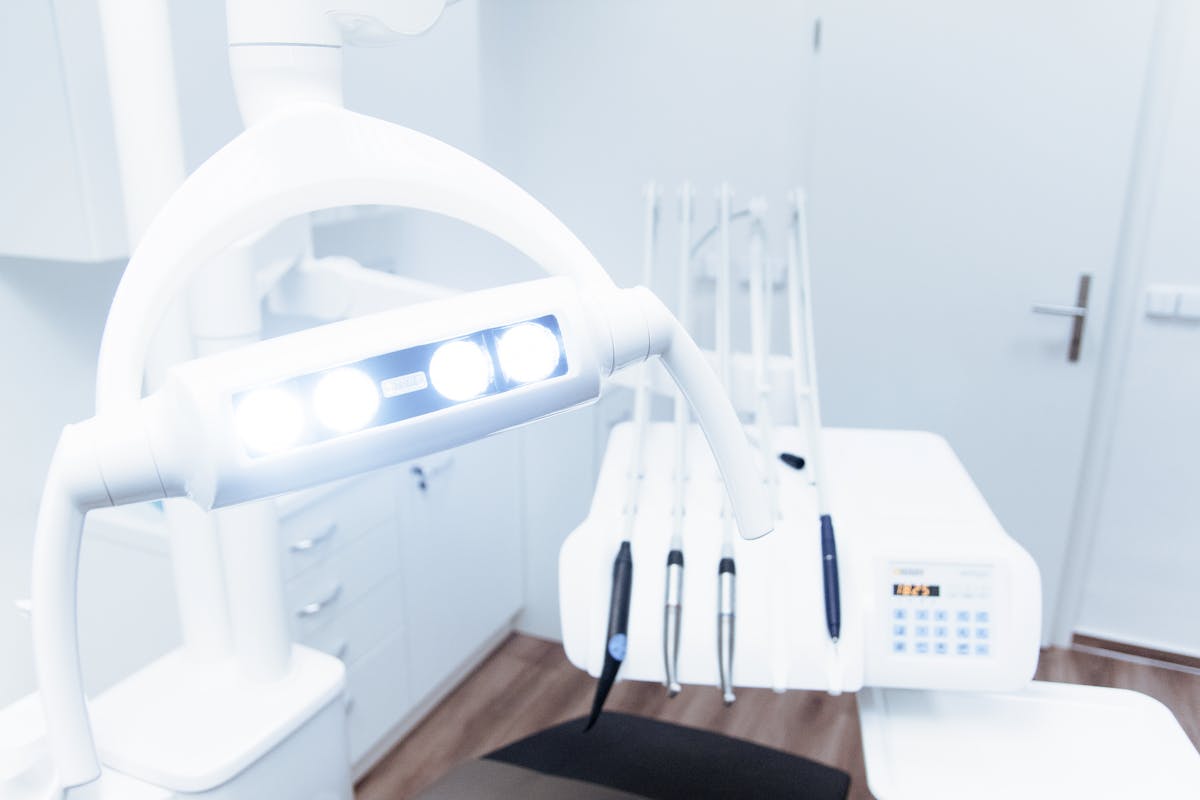
Photo: Daniel Frank / Pexels
The Practical Reality: It's Both, Not Either/Or
Here's what we see in the most efficient practices: they use both handpiece and tabletop systems.
A typical workflow looks like this:
- Routine, low-complexity prophy appointments (the majority of your patient base) → Handpiece system
- Moderate subgingival disease, periodontal maintenance, or high-volume days → Tabletop system
- Complex periodontal cases → Full-featured tabletop system
This approach optimizes for clinical outcomes (each case gets the right tool) and practice efficiency (you're not paying for tabletop capability you don't use on every patient). The capital investment is higher, but the clinical leverage is significantly better.
Brands in Alphabetical Order
The manufacturers mentioned in this article:
- Acteon
- Dentsply
- EMS
- Hu-Friedy
- Mectron
- NSK
- W&H
- Woodpecker
Conclusion: Not a Binary Choice
Cordless and portable air polishing systems are not replacing tabletop units—they're supplementing them. For the right practice, in the right context, a handpiece-only system offers real advantages: lower cost, simpler infection control, and adequate performance for routine prophylaxis. But they have clear limitations when it comes to power, efficiency, and clinical versatility in complex cases.
The real answer to whether cordless systems are "ready" is this: they're ready for their intended use case. The question you should ask instead is whether that use case matches your practice's patient volume, case complexity, and financial capacity.
Most practices of significant scale are finding the answer in a hybrid model. Your toolbox is bigger, and your ability to deliver consistent clinical outcomes improves with it.