Introduction
The European air polishing market has reached a critical inflection point in 2026. What began as a niche innovation two decades ago has evolved into a mainstream prophylaxis technology across major European dental practices. With minimally invasive dentistry becoming the clinical standard and patient comfort expectations rising across demographics, air polishing devices and powders are now essential to competitive hygiene programs.
This analysis examines market size, geographic distribution, competitive positioning, and the convergent trends reshaping the industry heading into 2027.
Market at a Glance
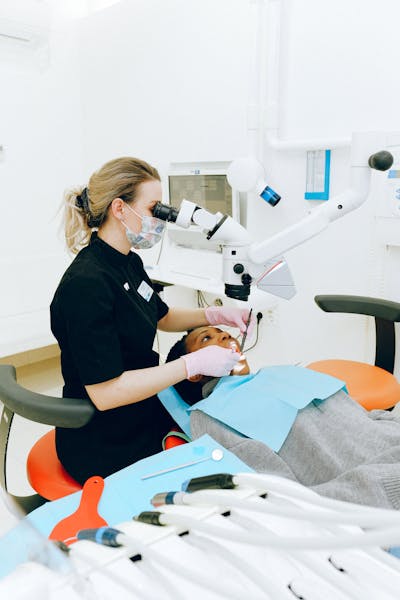
Photo: fauxels / Pexels
How large is the market?
The global dental air-polishing systems market reached an estimated USD 953.98 million in 2026 and is projected to grow at a CAGR of 5.94% through 2035, reaching USD 1,603.54 million by the end of that decade, according to Precedence Research. Tabletop air-polishing units account for approximately 60% of segment revenue; dental clinics (rather than DSOs or chain practices) represent roughly 63% of buyers. Our air polishing market overview sets out which brands make up the category's player tier.
Europe is one of four meaningful regions in the category alongside North America, Asia-Pacific, and Latin America. Asia-Pacific is the fastest-growing region globally (CAGR ~6.5%), with Europe trailing modestly but maintaining a more mature installed base. The European story is less about category growth in aggregate and more about where within Europe demand is concentrating.
For broader context, the global dental market itself was valued at USD 44.71 billion in 2026 (Fortune Business Insights), with Preventive & Periodontal Solutions positioned as the fourth of five fastest-growing dental categories — behind digital dentistry, orthodontics, and implants & prosthetics. Air polishing sits squarely within this preventive segment and benefits from the same tailwinds: ageing populations, rising demand for minimally invasive care, and the growing implant-maintenance burden. See where preventive care sits in the 2026 global dental market and what Q4 2025 earnings from Dentsply Sirona, Straumann and Align signal.
The structural drivers underneath the headline figures are three:
- Minimally invasive clinical consensus: European dental associations and evidence-based clinical pathways have increasingly endorsed air polishing as preferable to manual instrumentation for biofilm removal on healthy or recovering tissues.
- Patient comfort demand: As private practice dentistry strengthens and patient experience becomes a competitive differentiator, air polishing — quieter, faster, and less traumatic than ultrasonic scaling — has become patient-facing value.
- Hygienist autonomy and time efficiency: Dental hygienists across Europe report that air polishing reduces appointment time and physical strain, increasing practice productivity while allowing more complex cases per day.
Geographic Breakdown
European growth is geographically uneven. Public market-momentum reports consistently flag three clusters:
- High-growth markets — Spain, Portugal, CEE Baltics: Spain and Portugal are both seeing accelerated air-polishing adoption, driven by private-practice expansion, rising patient expectations for comfort-led prophylaxis, and clinic-level investment activity. The CEE Baltics — Estonia, Latvia, Lithuania — follow a similar curve: smaller absolute markets, but among the highest year-on-year growth rates in EU prophylaxis equipment spend.
- Stable markets — Germany, Italy: Germany remains the largest absolute European market by installed base, with a mature clinical-education ecosystem and proximity to manufacturers (W&H in Austria, EMS in Switzerland). Italy similarly has a deep installed base. Growth in both has plateaued — these are replacement-cycle markets rather than greenfield expansion.
- Slower markets — France, Slovakia, Slovenia, Croatia: France lags despite strong private-practice density, in part because of reimbursement structure and slower clinical-adoption cycles. Slovakia, Slovenia, and Croatia remain price-sensitive markets where high-end equipment investment is constrained.
- Other developed markets — UK, Nordics, Benelux: The United Kingdom remains a significant market, particularly post-pandemic where efficiency gains became a procurement priority for corporate dental groups. Scandinavia (especially Finland and Sweden) shows steady adoption supported by strong continuing-education culture. Belgium and the Netherlands track closer to Germany than to high-growth Iberia.
The combined picture across these clusters explains why Europe-wide growth figures often understate what is happening at the high-growth end of the distribution: aggregate growth is moderated by replacement-cycle stability in the largest absolute markets.
The Competitive Landscape
Seven companies dominate European air polishing: Acteon, Dentsply, EMS, Mectron, NSK, W&H, and Woodpecker (listed alphabetically). Market concentration is moderate—no single player exceeds 25% share—reflecting the specialized nature of the category and regional manufacturing/distribution preferences.
Market Leaders and Positioning
Acteon (French manufacturer, part of the Acteon Group) maintains strong presence in France, the UK and Iberia with established distributor networks and a broad hygiene product portfolio. Acteon's air-polishing range comprises the AIR-N-GO handpiece family (sodium bicarbonate, calcium carbonate, glycine options) and the OPUS combined tabletop system launched at IDS 2025, targeting both general and specialist practices.
Dentsply leverages its global scale and relationships with large dental chains and DSOs, particularly strong in Germany and UK. Its Cavitron ultrasonic and accessory portfolio makes cross-selling natural; air polishing fits integrated prophylaxis strategies.
EMS (Electro Medical Systems, Switzerland) is the innovation leader in powder formulations and is widely credited with early commercialization of erythritol-based powders. Particularly strong in Germany, Scandinavia, and with specialists (periodontists, implantologists). Premium positioning.
Mectron (Italy) competes aggressively in Italy, Spain, Southern France, and increasingly in Central Europe. Pricing is competitive; innovation focus is on cordless technology and user experience. Growing market share in mid-market practices.
NSK (Japan, global) emphasizes handpiece quality and reliability. Known for durable, well-engineered devices. Market presence is strongest in Northern Europe and among specialists seeking high-end equipment.
W&H (Austria) dominates its home region and Southern Germany through strong distributor relationships and continues innovation in prophylaxis systems (e.g., Tigon, Proxeo). Premium-positioned but with robust after-sales support.
Woodpecker (China) has rapidly gained share in price-sensitive markets (Central/Eastern Europe, Parts of Southern Europe) with aggressive pricing and improving product quality. Growing presence in Western Europe among budget-conscious group practices and emerging DSOs.
No player has achieved market leadership through air polishing alone; success correlates with integrated prophylaxis portfolios, distribution reach, and regional proximity.
What trends are reshaping the market?
1. Cordless Adoption Wave
Cordless air polishing handpieces are gaining adoption. Mectron, W&H, and emerging Chinese brands are releasing battery-powered models that improve ergonomics and reduce operatory setup complexity. The implications of this shift are explored in depth in our analysis of cordless versus tabletop air polisher decisions, which examines how battery improvements are expected to drive further adoption in coming years.
2. The Erythritol Inflection — with EU patent caveat
Erythritol-based powders — gentler on soft tissue, no fluorosis risk, suitable for peri-implant maintenance — have transitioned from specialist preference to mainstream adoption across many European markets. A critical EU-specific note: EMS holds the European patent on erythritol as an air-polishing powder. As a result, non-EMS devices sold in the EU — Acteon, Dentsply, Mectron, NSK, W&H, Woodpecker — cannot use erythritol. They run sodium bicarbonate, glycine, or calcium-carbonate formulations instead. Woodpecker's marketed "Super Powder" in Europe, for example, is a glycine formulation rather than an erythritol one.
This patent dynamic shapes the segment's competitive structure: erythritol-specific clinical claims effectively become EMS-only claims in the EU until the patent expires. Competitors compete on glycine and sodium-bicarbonate formulations, with the clinical evidence comparing those powders to erythritol becoming the most-watched evidence stream in the category. The full evidence picture is summarised in our erythritol versus glycine clinical evidence review; equipment-powder pairings are evaluated in the 2026 buyer's guide.
3. Chinese Manufacturers Entering the Market
Woodpecker and several emerging Chinese OEMs are gaining traction in price-sensitive segments. While quality gaps persist (particularly in handpiece durability and precision), competitive pricing is capturing budget-conscious practices and DSOs in Central/Eastern Europe and value-focused segments in Western Europe. This trend exerts competitive pressure across the category.
4. Digital Workflow Integration
Integration of air polishing data into practice management systems and patient records is accelerating. Protocols linked to digital treatment plans, automated powder recommendations, and consumables auto-reordering are emerging. This favors larger vendors with software ecosystems (Dentsply, Acteon) but creates opportunities for software-focused startups.
5. Powder Compatibility Wars
Proprietary powder cartridges and compatibility ecosystems are emerging as competitive moats. Some manufacturers are moving toward closed-loop powder systems to increase consumables revenue. Practitioners view this unfavorably, creating regulatory and market pressure toward open standards. The tension between proprietary margins and practitioner freedom remains unresolved.
What are the key challenges and headwinds?
Price Pressure Across the Segment
Chinese competition and DSO consolidation are exerting downward pressure on equipment pricing. Manufacturers are responding by shifting margin emphasis to consumables (powders, accessories) and service models.
Regulatory Fragmentation
While CE marking provides baseline EU compliance, divergent national or regional reimbursement policies (particularly around prophylaxis codes in public health systems) create complexity. Some countries recognize air polishing as distinct from traditional scaling; others do not, affecting reimbursement and adoption in public-sector dentistry.
Clinical Evidence Gaps
While mechanistic benefits of air polishing are well-established, long-term comparative outcome data versus traditional scaling remains limited. This slows adoption in evidence-driven public health contexts and among skeptical practitioners. Vendors are increasingly funding clinical research to address this gap.
Consumables Availability and Sustainability
Supply chain disruptions (particularly for specialty powders post-COVID) and rising raw material costs have strained consumables margins. Sustainability concerns—single-use cartridges, powder waste—are emerging as practitioner and regulatory concerns, particularly in Scandinavian and Central European markets.
What can we predict for 2027-2028?
Based on current market dynamics, the following developments are likely:
- Continued Market Growth: Geographic expansion in Southern and Central Europe and further adoption of cordless technology are expected to support market growth.
- Increased Cordless Penetration: Battery and cost improvements will drive higher adoption of cordless handpieces, particularly among efficiency-focused practices.
- Erythritol Adoption: Erythritol powders are expected to continue gaining market share, becoming the default choice for many general prophylaxis applications, with sodium bicarbonate retained for specialty uses.
- Consolidation Pressure on Mid-Tier Players: Margin pressure and Chinese competition will likely drive consolidation among European regional players, favoring global leaders and niche specialists.
- Regulatory Clarity on Proprietary Powders: EU regulatory bodies may issue guidance on powder compatibility, potentially limiting proprietary cartridge strategies.
- DSO and Group Practice Dominance in Western Europe: As corporate dentistry grows, purchasing power will increasingly concentrate, benefiting large vendors with volume pricing and integrated software solutions.
- Emerging Market Entry (Central/Eastern Europe, Iberia): Chinese competitors and value-positioned European brands are expected to deepen penetration in currently under-served markets.
Conclusion
Europe's air polishing market is at an inflection point—transitioning from innovation-driven early adoption to mainstream utility. Market fundamentals remain strong: clinical evidence, patient demand, and operational efficiency gains continue to drive adoption. However, competitive dynamics are shifting. Chinese entry, pricing pressure, and margin compression are forcing strategic choices: vertical integration, geographic focus, or niche positioning.
For practitioners, the near-term outlook is favorable: greater product choice, competitive pricing, and accelerating innovation in cordless technology and powder formulations. For vendors, 2027–2028 will likely see winners emerge from consolidation and those who secure digital workflow integration and consumables loyalty. The independent voice in European dental prophylaxis will be watching closely.
For published specifications and public prices of the combined tabletop systems, including the EMS AIRFLOW Prophylaxis Master, Mectron Combi Touch and NSK Varios Combi Pro2, see Combined Tabletop Systems Compared.